
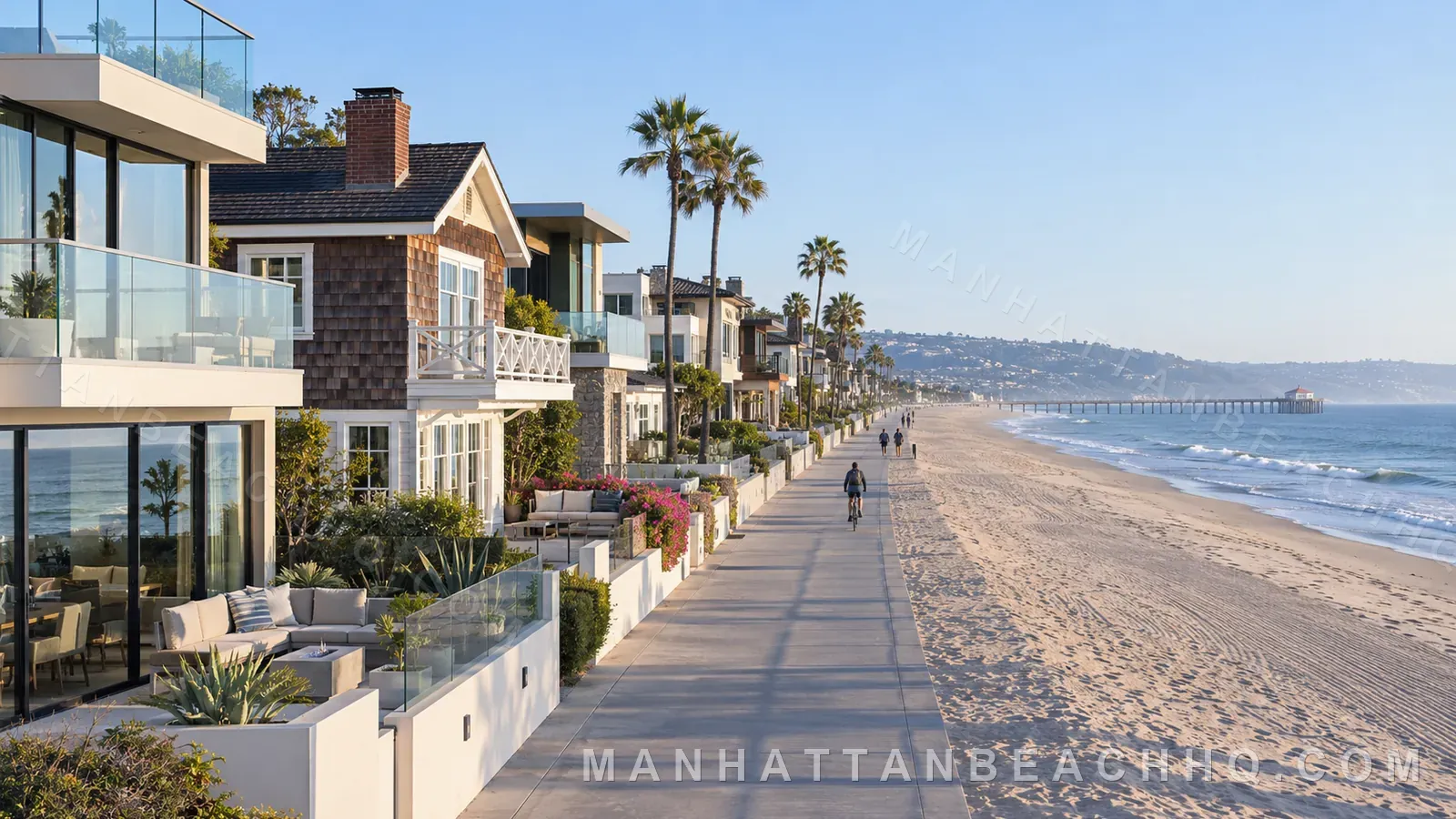
What The Strand is
The Strand is the walkway that runs along the beach in Manhattan Beach. In a 2003 staff report on the city's coastal program, the California Coastal Commission described it as the main public sidewalk and boardwalk running parallel to the shoreline. Wikipedia's article on the city notes that oceanfront homes line its bike path and walking lane. Those two sentences explain most of what makes a Strand address different: the home faces the ocean directly, and the space between the house and the sand is a public path that people walk, run and ride along all day.
Manhattan Beach is a compact city. It was incorporated in 1912, the 2020 Census counted 35,506 residents, and its total area is 3.9 square miles, with 90266 as its main ZIP code. Only the row of homes along the beach has a Strand address, so they are a small subset of the city's single-family listings at any one time. You can see the current set, matched by street address, at The Strand.
Strand-front, walk street and a block back
Buyers often use "beachfront" loosely, so it helps to separate three kinds of address. The first is a home whose front door or ocean side is on The Strand itself. The second is a home on a walk street, one of the streets closed to cars that lead from inland blocks down toward the beach. The Coastal Commission's report says the city's walk streets provide direct vertical access to The Strand and the beach from inland areas, and that homes on either side have been allowed to use the edges of the public right-of-way as yard areas. The third is everything a block or more back, where a house may have an ocean view from an upper floor but no frontage at all.
Each type comes with its own questions. On The Strand, ask how the home's frontage, gates and any yard relate to the public walkway. On a walk street, the yard you see may sit partly on public right-of-way under an encroachment arrangement, and private encroachments on streets, walk streets, sidewalks and alleys fall under Chapter 7.36 of the Manhattan Beach Municipal Code. The 2003 report describes height limits for landscaping and other encroachments, but those rules have been amended since, so confirm the current version with the city before you plan any change to a walk-street frontage. Our Walk Streets page collects what the public record says about them.
How Strand homes show up in the listings
Listings on this site come from the listings local agents publish and refresh four times a day. Only single-family homes are included, so condominiums and townhomes on or near The Strand are not part of these counts. We decide that a home is on The Strand by its street address in the listing record: if the address contains the word Strand, it appears on the Strand page. That is a deliberately literal rule. A listing agent may describe a home as steps from the sand, and that may be true, but it does not put the home on The Strand.
The oceanfront page at Oceanfront Homes uses a slightly wider rule. It shows every single-family home with a The Strand address plus any Manhattan Beach listing whose listing record has the waterfront flag set. Comparing the two pages is a quick way to see whether a listing's waterfront claim comes from its address or only from a checkbox the listing agent filled in.
What the waterfront flag does and does not tell you
The waterfront flag and the view field in a listing record are entered by the listing agent. They are useful for searching, but they are descriptions, not surveys. Two homes can both carry the flag while one sits on The Strand and the other is a block up with a partial view. Before you compare prices, confirm three things in person or in the disclosures: whether the lot actually fronts The Strand, what the ocean view is from each floor, and whether anything planned nearby could change it.
For asking prices, use the live pages rather than any figure in an article. Our Homes for Sale page lists every single-family home for sale in the city with the range and median computed from the listings on the page, and Home Values & Recent Sales shows recent closed sales alongside current asking prices. Asking prices are not sale prices, and on a small set of beachfront homes a single listing can move a median a long way.
Permits and the coastal zone
Section 30600 of the California Coastal Act requires a coastal development permit for development in the coastal zone, and the Coastal Commission certified the City of Manhattan Beach Local Coastal Program on May 12, 1994. Whether a particular lot is in the coastal zone, and which body reviews work on it, is a question for the city's planning staff. If you are buying a Strand home to remodel or rebuild, ask early which agency issues the permit for that address and what approvals the current owner already has.
Costs at the closing table
Los Angeles County charges a documentary transfer tax when a property sells, at $0.55 for each $500 of value. Manhattan Beach is not on the County Registrar-Recorder's list of cities that add their own transfer tax, so only the county rate applies. Agent compensation is a separate cost: the National Association of REALTORS consumer guide states that compensation between you and your real estate professional is negotiable and not set by law.
Questions buyers ask about The Strand in Manhattan Beach
What is The Strand in Manhattan Beach?
It is the public walkway along the beach, which the California Coastal Commission describes as the main public sidewalk and boardwalk running parallel to the shoreline, and oceanfront homes line its bike path and walking lane.
How does this site decide that a home is on The Strand?
By the street address in its listing record. If the address contains the word Strand and the property is a single-family home, it appears on the Strand page; marketing descriptions alone do not count.
What is the difference between The Strand and a walk street?
The Strand runs along the beach, while walk streets are car-free streets that give pedestrians direct access to The Strand and the beach from inland blocks, with homes on either side often using the edge of the right-of-way as yard.
Do I need a permit to rebuild a beachfront home in Manhattan Beach?
Development in the coastal zone needs a coastal development permit under Section 30600 of the Coastal Act, and the city has a Local Coastal Program certified in 1994, so ask the city which permits apply to the specific address.
Where to go next
See every single-family home currently listed with a Strand address at The Strand, the wider oceanfront set at Oceanfront Homes, and the full city at Homes for Sale. If you own a beachfront home and want to know what it could sell for, Home Values & Recent Sales shows recent closed sales and lets you request an opinion of value from a licensed local agent. If you are choosing an agent, our guide at Choosing a Luxury Agent covers how to check a California license and what to ask.
Sources and review scope
Sources checked 2026-11-20. The notes identify which facts each publication supports.
- California Coastal Commission: staff report on the City of Manhattan Beach LCP amendment, December 17, 2003
The Strand as the main public sidewalk and boardwalk parallel to the shoreline; walk streets giving vertical access and homes using right-of-way edges as yards; Municipal Code Chapter 7.36; LCP certified May 12, 1994.
- Wikipedia: Manhattan Beach, California
Incorporation in 1912, the 2020 Census population of 35,506, total area of 3.9 square miles, ZIP code 90266, and oceanfront homes lining The Strand's bike path and walking lane.
- California Coastal Commission: California Coastal Act
Section 30600 requires a coastal development permit for development in the coastal zone.
- Los Angeles County Registrar-Recorder/County Clerk: Documentary Transfer Taxes
The county rate of $0.55 per $500 of value and the list of cities with their own rate, which does not include Manhattan Beach.
- National Association of REALTORS: Consumer Guide to Written Buyer Agreements
Compensation between a consumer and their real estate professional is negotiable and not set by law.
Written by
Publisher and editor, Manhattan Beach HQ
Manhattan Beach HQ is an independent research publication. This article is not professional advice.